
Case study
How Much Can an Apartment Earn on Lake Garda? The Altavista Case Study

Like any business, turning an apartment into a holiday rental takes time before it starts producing meaningful results. Today we’ll answer a simple question: how much can an apartment earn on Lake Garda?
Buying a property and listing it online is not enough.
Building a business that works takes positioning, photography, reviews, distribution across channels, pricing management, attention to the guest experience and, above all, the ability to analyse results and improve over time.
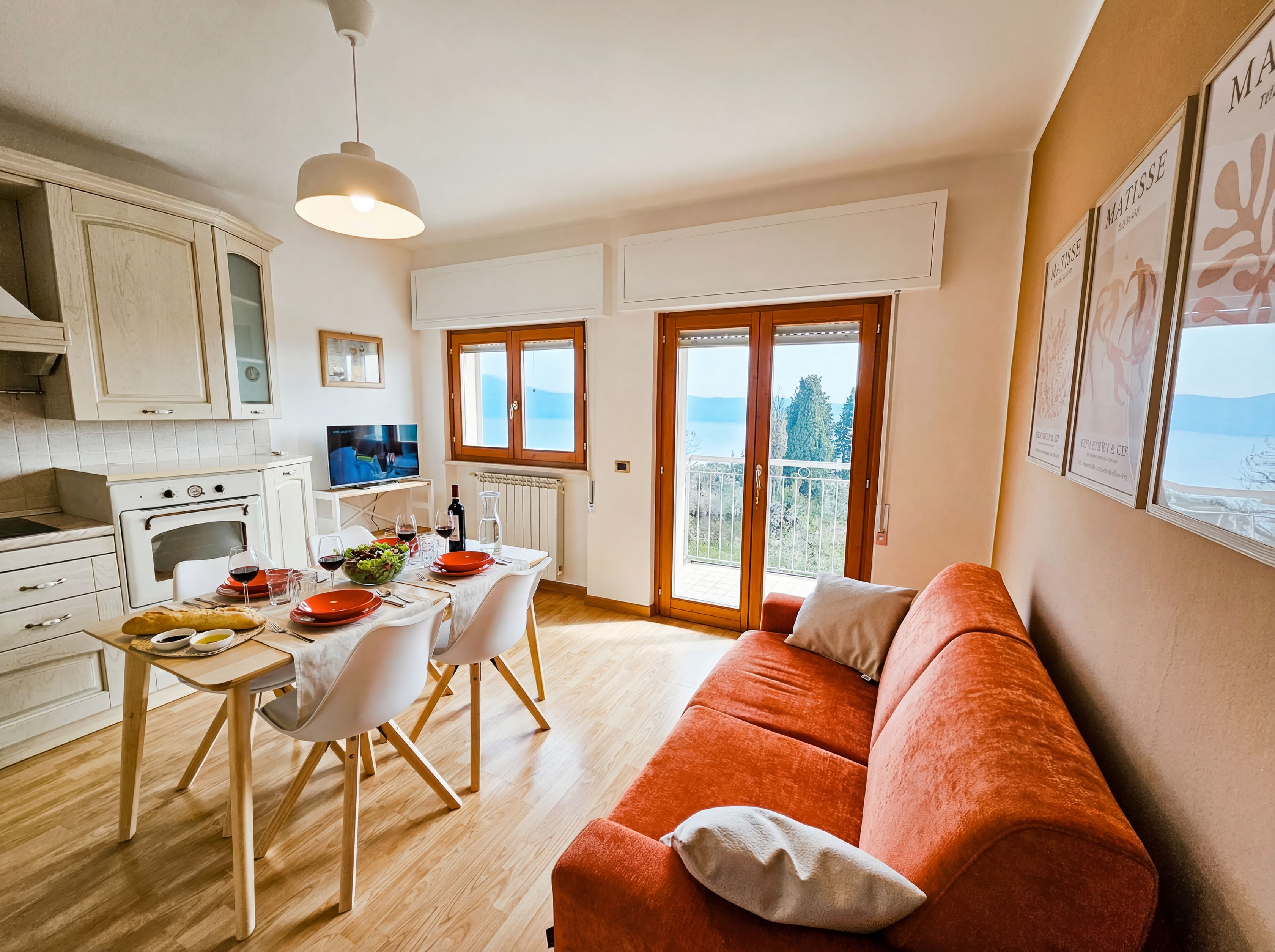
To answer this question, we decided to start from a concrete case: Altavista, in Toscolano Maderno.
An apartment bought at the beginning of 2025 for around €230,000, then improved, furnished and marketed as a holiday rental.
So this article is not about a simulation built on paper.
We will analyse real management data: how much revenue was generated, how many nights were sold, which periods were strongest and which stayed empty, and how much platform commissions, taxes, cleaning and professional management weighed on the result.
Above all, we will try to understand one thing:
how much of the revenue generated by a holiday rental actually stays with the owner, and how much potential is left to increase it?
Because revenue is only the starting point.
The real return of a property is measured once we start subtracting all the costs needed to produce it, and now we’ll really answer the question: how much can an apartment earn on Lake Garda?
Chapter 1
Altavista: from apartment to tourism product
Before talking numbers, we have to start from the property.
Because a holiday rental is not just a collection of square metres, bedrooms and amenities.
It is a product that has to be recognisable, desirable and consistent with the people we want to reach.
Altavista starts from one very strong feature: the view over Lake Garda.
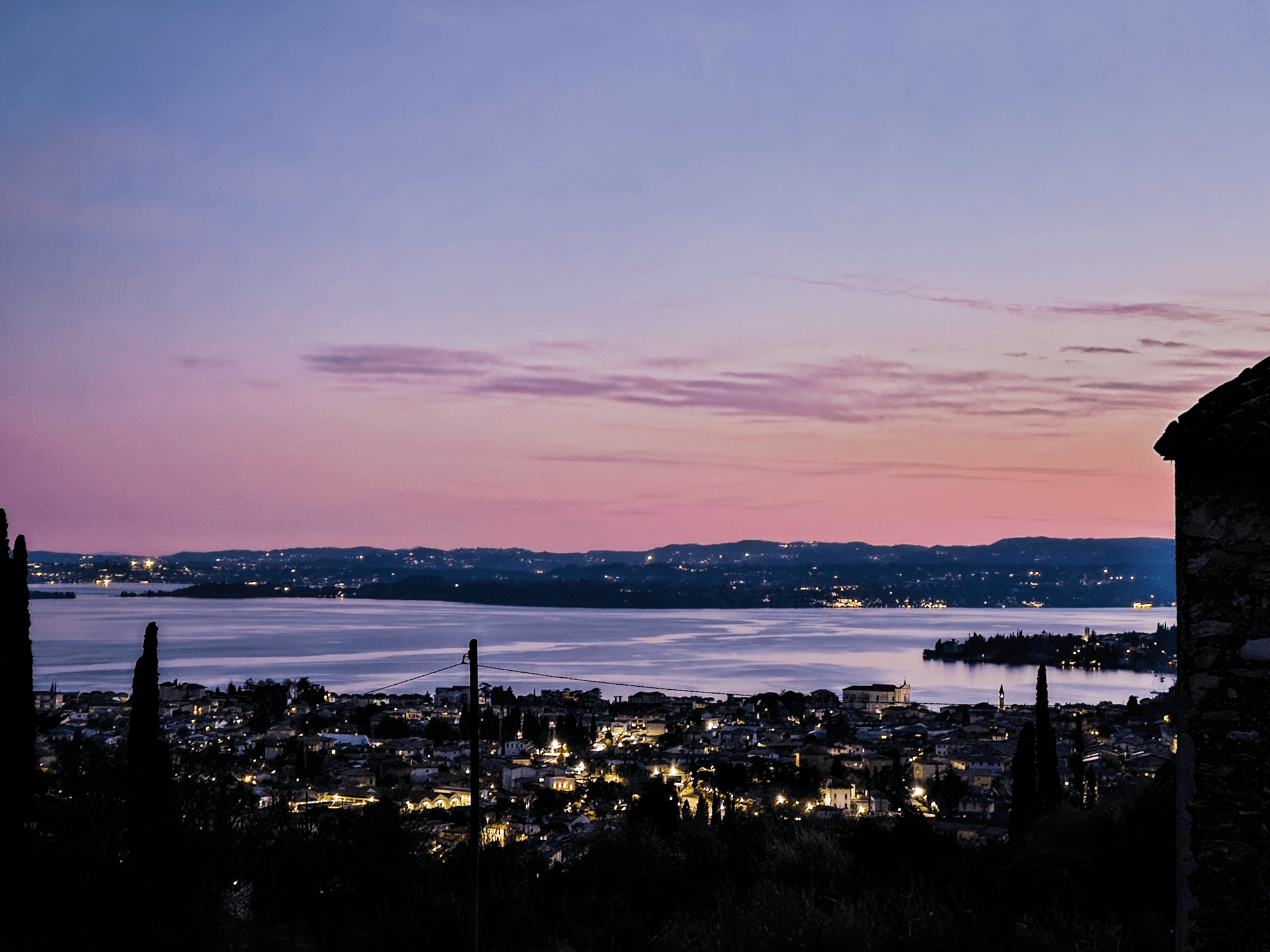
The apartment has a balcony with room to eat outdoors, two bedrooms and space for up to four people, with a double bed, a bunk bed and a sofa bed.
It has no swimming pool and doesn’t try to compete with the large villas of Lake Garda.
Its strength lies elsewhere: peace and quiet.
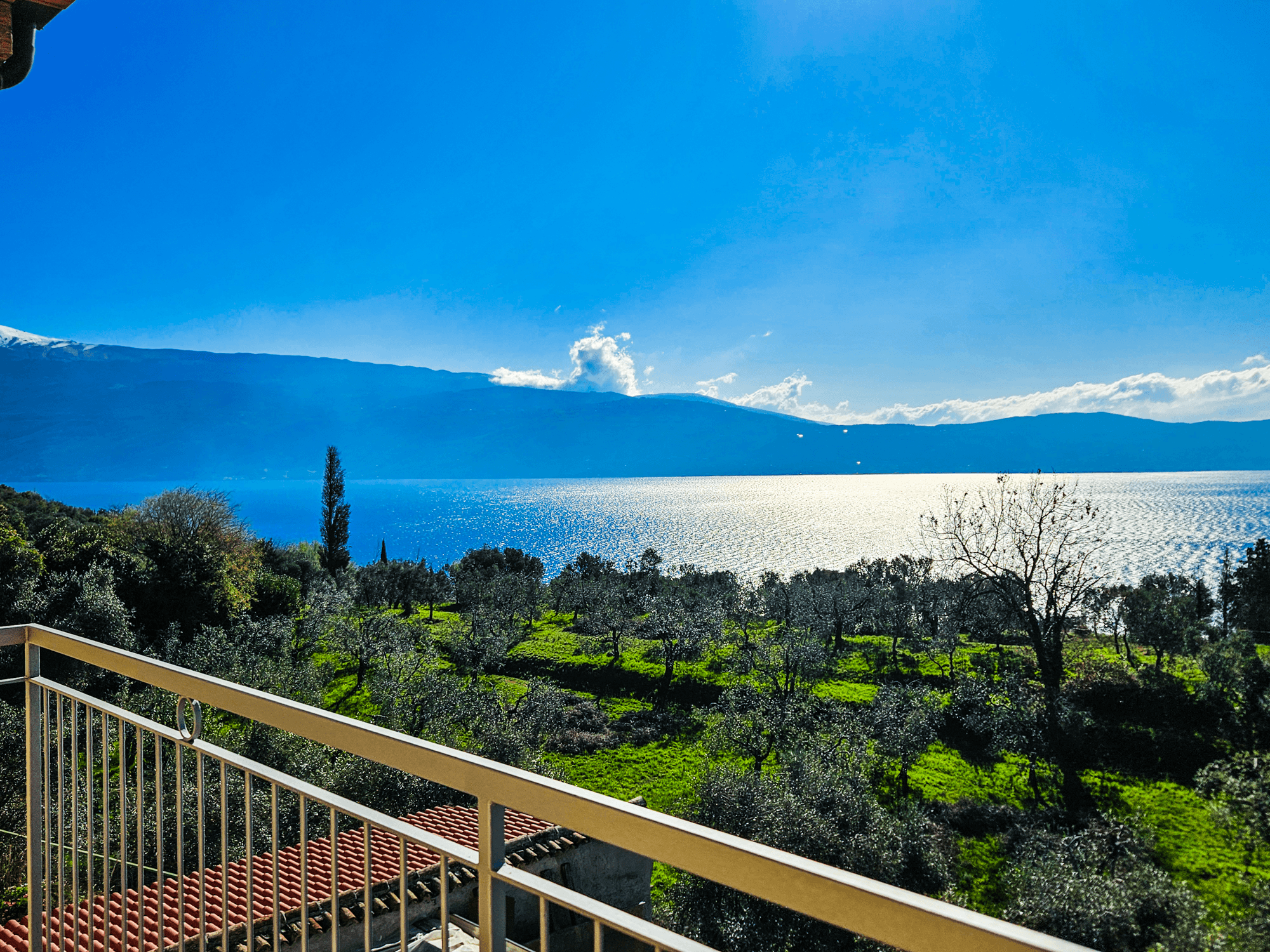
An apartment surrounded by nature, away from traffic, with the lake as its distinctive feature and the surrounding area as an integral part of the experience.
The initial investment
The apartment was bought at the beginning of 2025 for around:
€230,000(Apartment cost)
But buying the property was only the first step.
To turn it into a hospitality product, several improvements were made, some very simple and others more about how the spaces are perceived.
The goal was not a radical renovation.
It was to understand where small interventions could produce a concrete improvement in the experience and presentation of the property.
Small changes, a new perception
The improvements included:
- adding a sofa bed;
- repainting;
- new artwork and decorative elements;
- matching bedspreads;
- a desk for working from home;
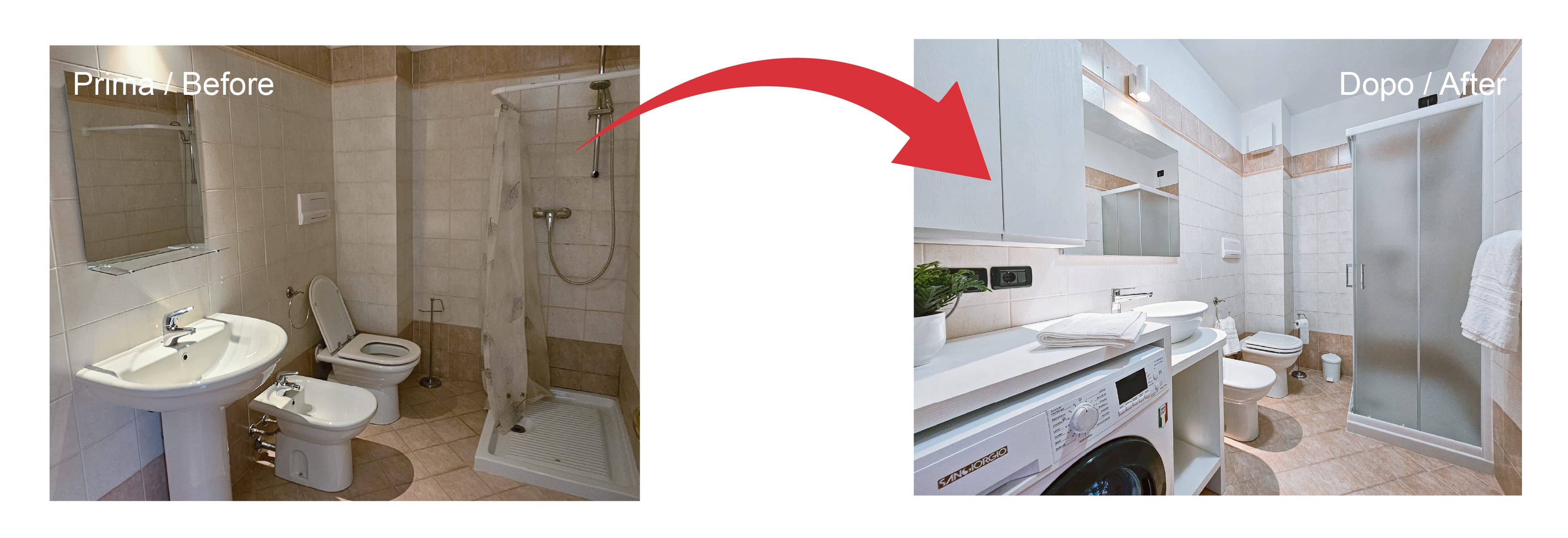
- a dishwasher and a new bathroom cabinet;
- replacing the shower;
- completing the hospitality essentials, including fast WiFi;
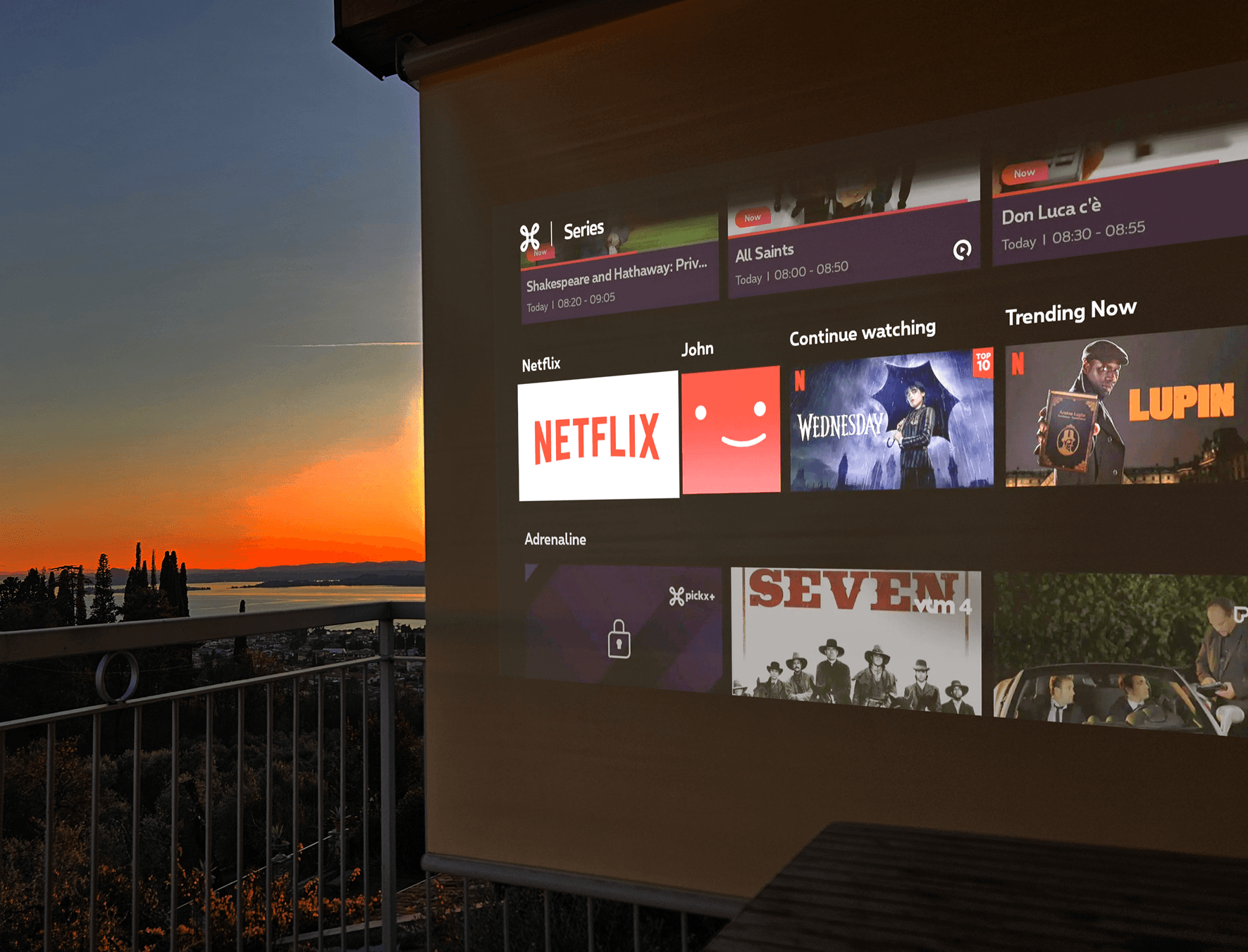
- a projector for outdoor movies;
- organising supplies and restocking.
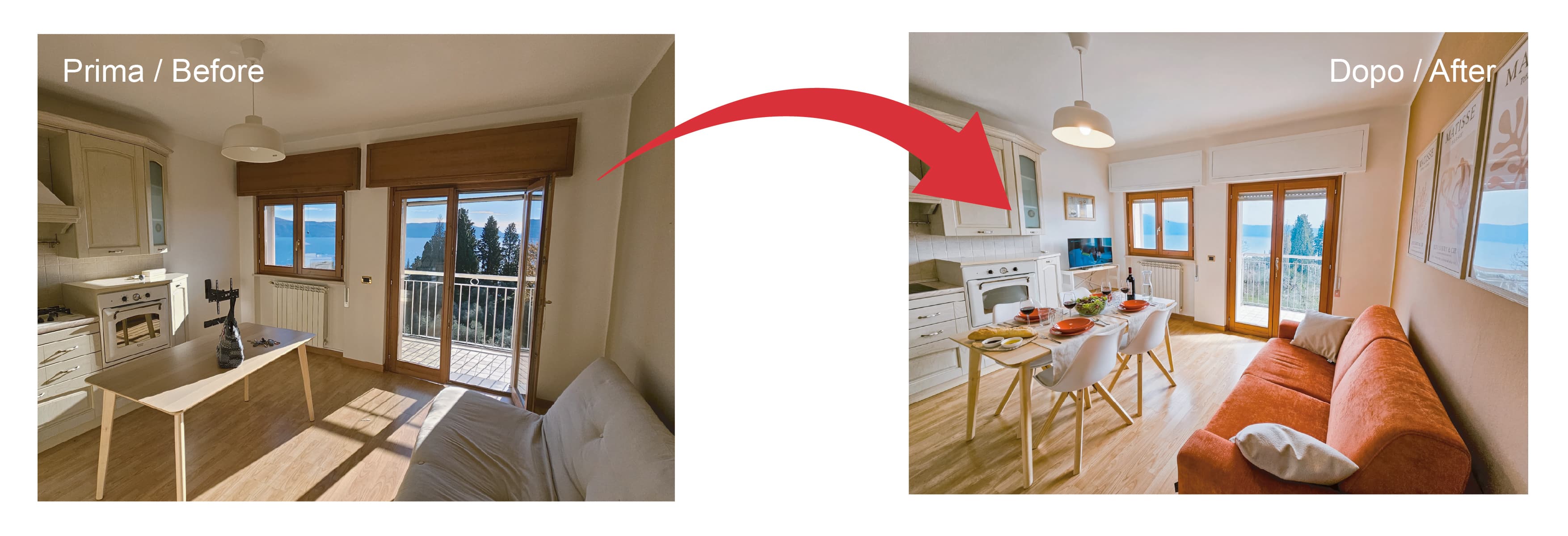
We didn’t just furnish the rooms
One of the things we worked on was giving each space a clear identity.
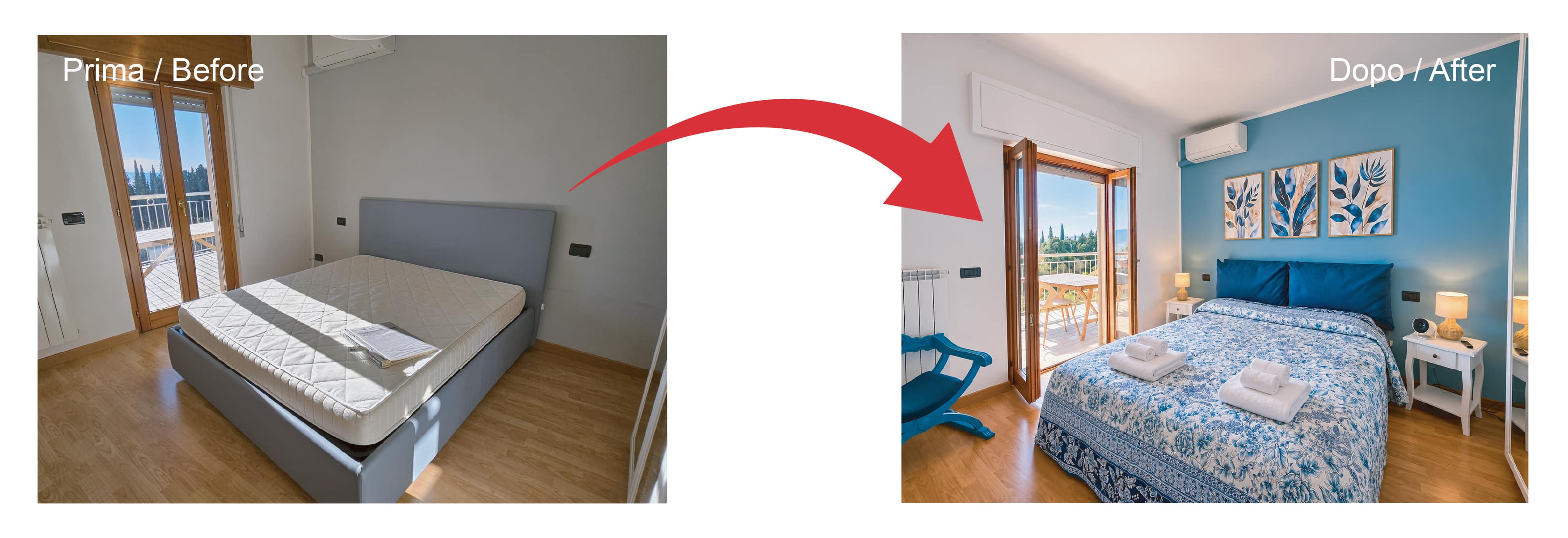
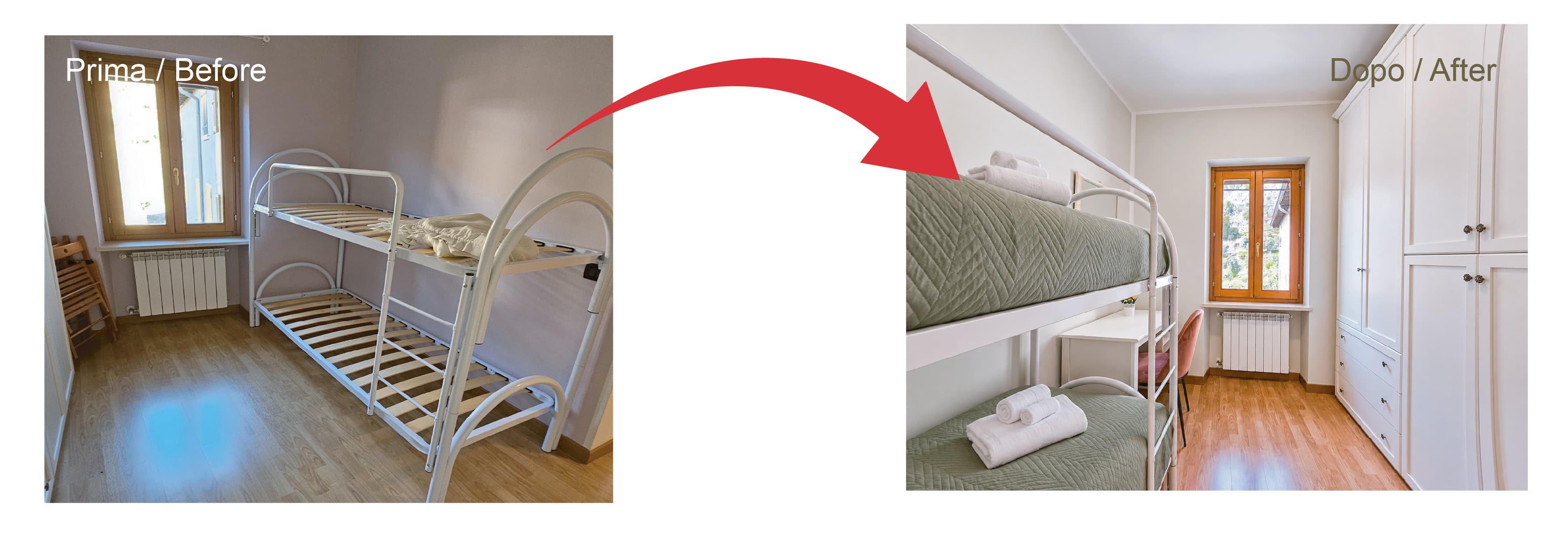
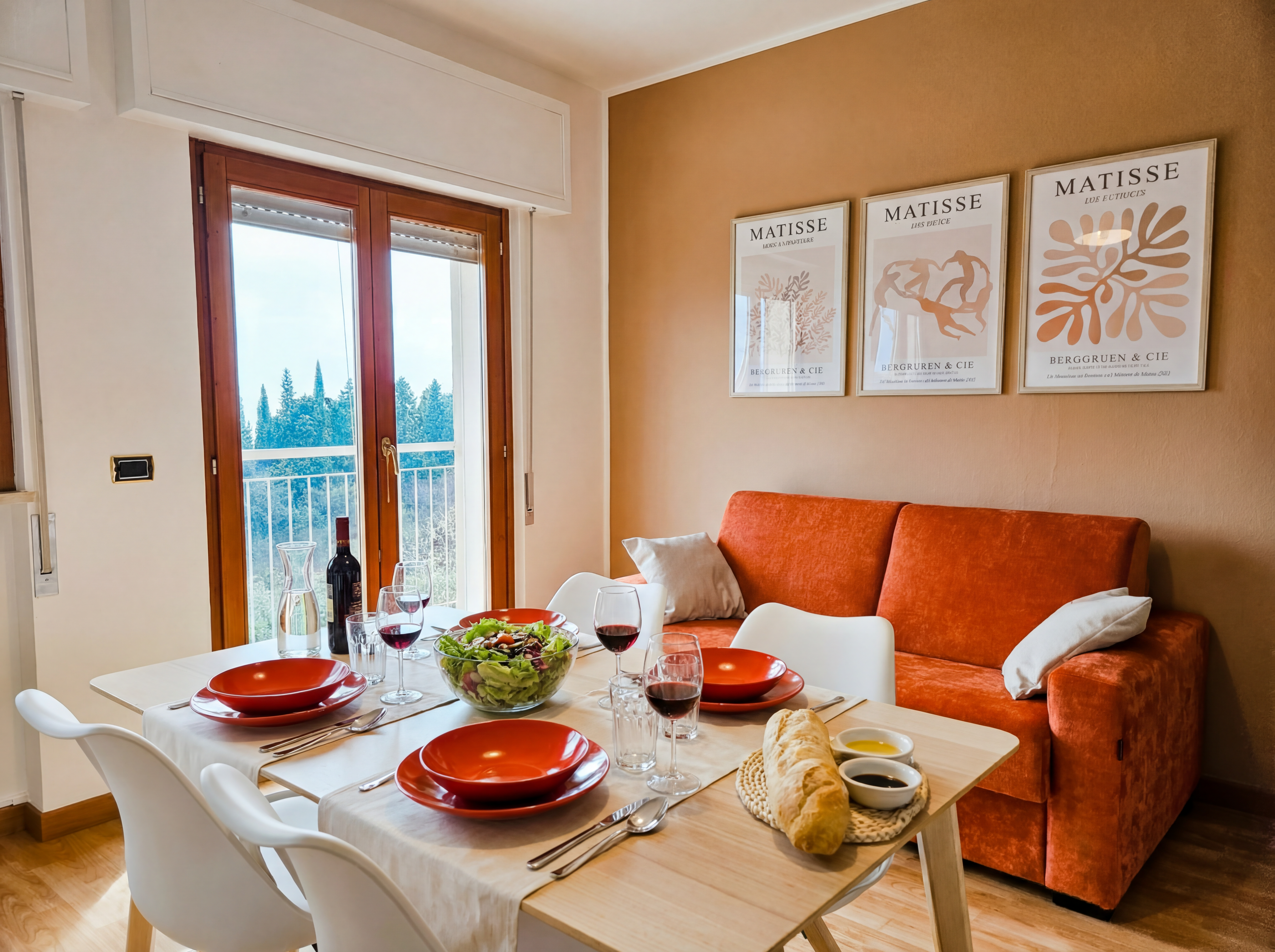
The rooms were interpreted through three colour and storytelling themes.
Lake Blue
The double bedroom, associated with the lake and the view.
Nature Green
The single bedroom, facing the natural landscape and the mountains.
Warm Red
The living area, designed as a warmer, more convivial space.
The goal was not simply to choose colours.
It was to create a recognisable common thread.
When someone sees a photo on Airbnb, Booking.com or Google, they shouldn’t just perceive a well-furnished room.
They should start building an idea of their stay in their mind.
This is where even seemingly small changes can become part of the property’s commercial strategy. The same goes for the bathroom, where a new shower and a washing machine with an integrated cabinet make the stay more comfortable.
To complete the set-up, we added a portable projector that guests can use to show films on the outdoor awning with a lake view or on the bedroom wall.
The area as part of the product
A holiday rental on Lake Garda is not chosen only for what is inside its walls.
The destination, the landscape, the distance from traffic, the view, the chance to experience the area and the feeling of tranquillity all contribute to the guest’s decision.
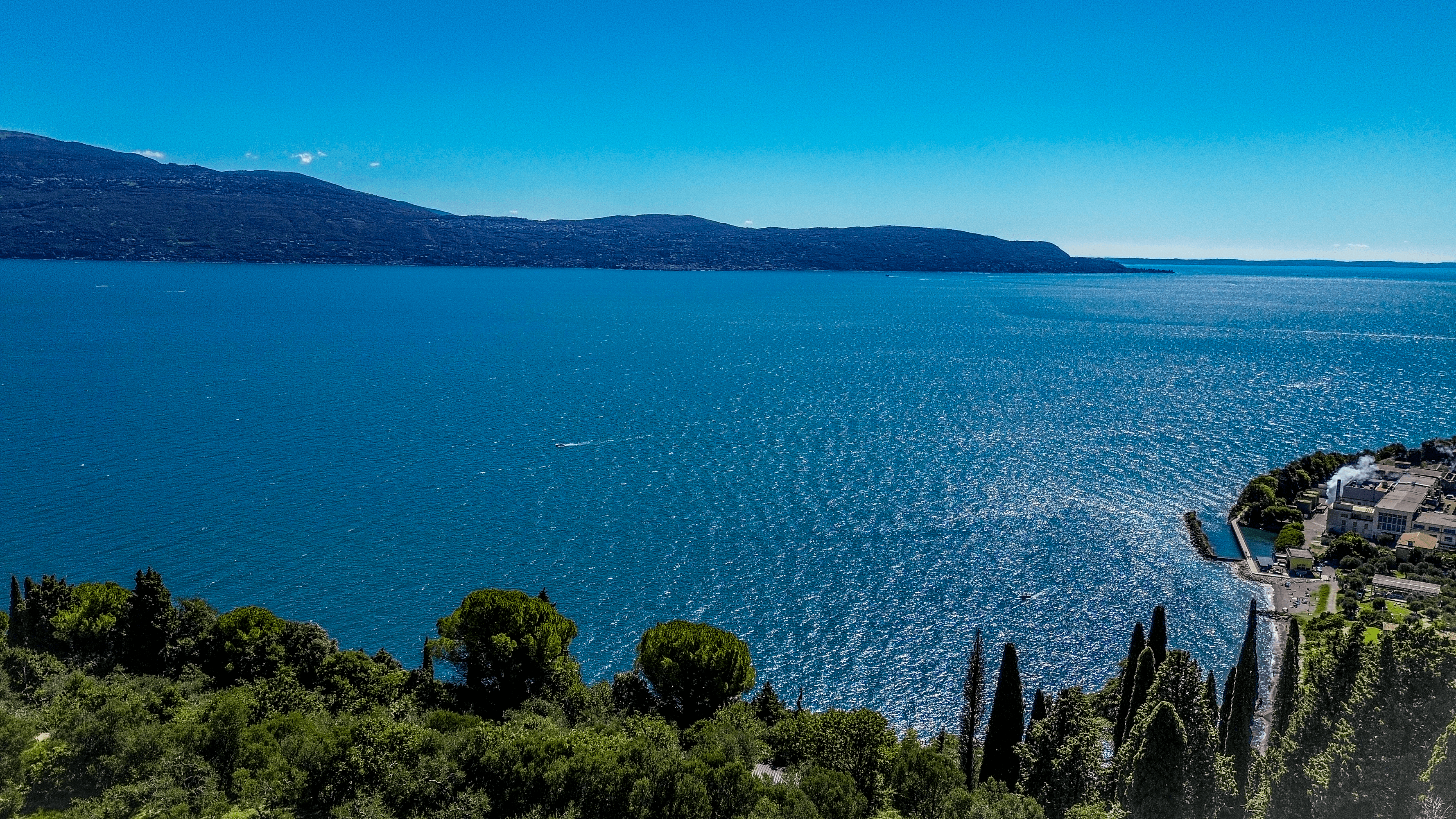
That is why, in marketing Altavista, the property and the area have to be told together.
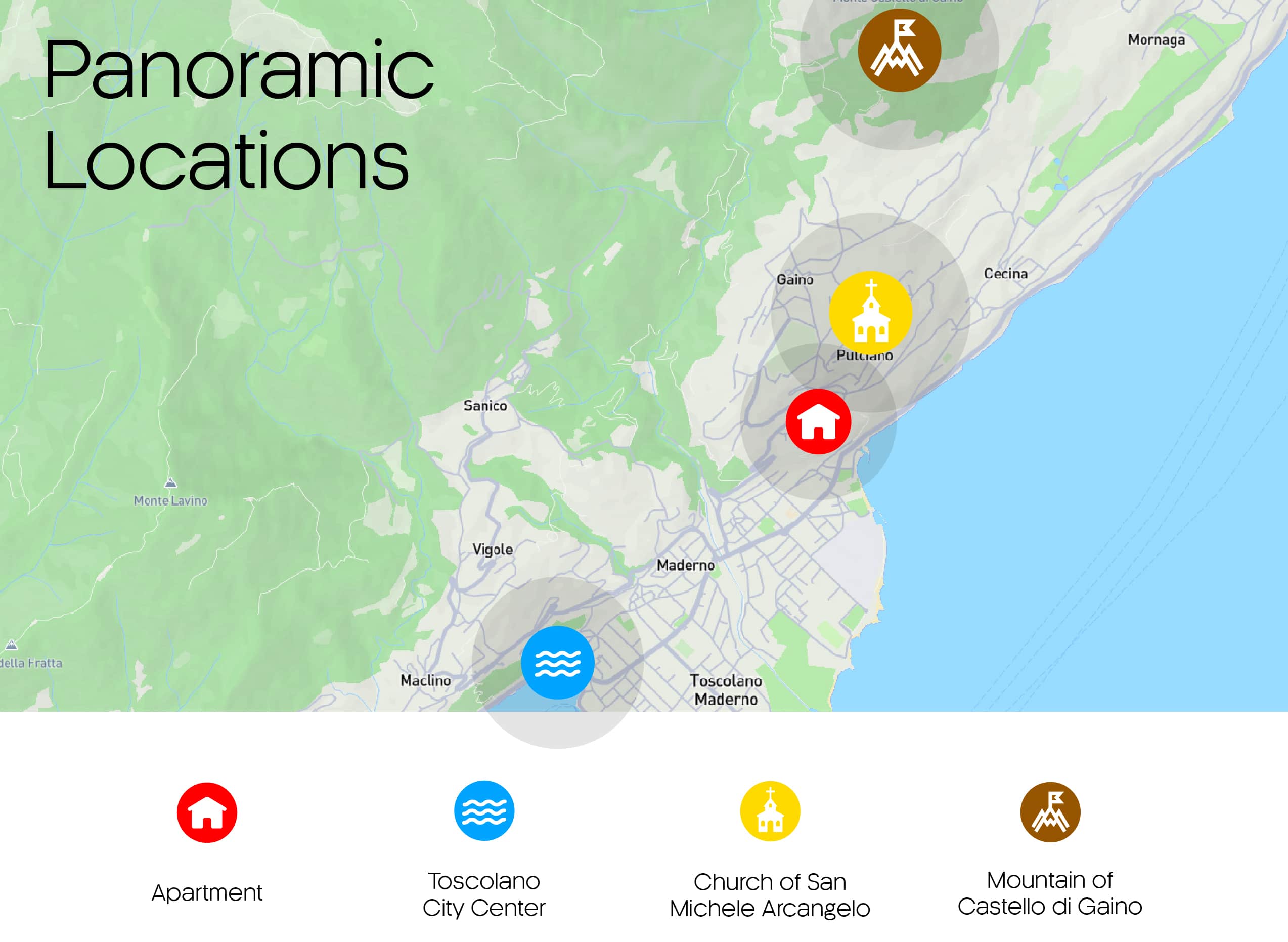
we are not just selling an apartment. We are selling a way of experiencing Lake Garda.
And this is exactly where positioning work begins.
Before even asking how much it can earn, we need to understand why someone should choose this particular apartment.
Chapter 2
The first year: building the market
So… how much can an apartment earn on Lake Garda?
Once the Altavista apartment had been bought and prepared, the most important part began: taking it to market and understanding how much the market was willing to pay for it.
The first year of a holiday rental is a special one.
There is no established review history yet, we don’t know the best rates for each period of the year, and we still have to understand which guests are most interested in the property.
In Altavista’s case, 2025 was also a genuine start-up year.
After the purchase, January and March were devoted to preparing the apartment, to the improvements described in the previous chapter and to the organisation needed to start marketing the property as a holiday rental, launching it in April 2025.
This means the 2025 calendar does not represent a year in which the apartment was simply put online and left to work for twelve months.
It was the first year in which we built the product, prepared the spaces, created the positioning and started collecting the first data from the market.
That is why the first goal was not simply to fill the calendar.
It was to build the product in the market.
The 2025 numbers
Once on the market, Altavista started generating its first bookings.
The 2025 owner statement shows 27 stays, for total revenue of €24,362.99.
The result is particularly interesting considering that the property needed an initial preparation period and that the strategy adopted was mainly short-term rental.
| Indicator | 2025 result |
|---|---|
| Bookings | 27 |
| Nights occupied | 163 |
| Occupancy over the year | 44.7% |
| Gross revenue | €24,362.99 |
| Purchase price | €230,000 |
| Gross yield on purchase price | 10.6% |
Revenue and booking figures are those reported in the GardaStays owner statement for 2025.
The word “gross” is crucial.
This 10.6% does not represent what actually stays with the owner.
To understand the real return, we need to consider every item that affects the final result.
We’ll do that in the next chapter.
163 nights sold: reading the figure correctly
In 2025 Altavista sold 163 nights, equal to about 44.7% occupancy measured against the 365 days of the year.
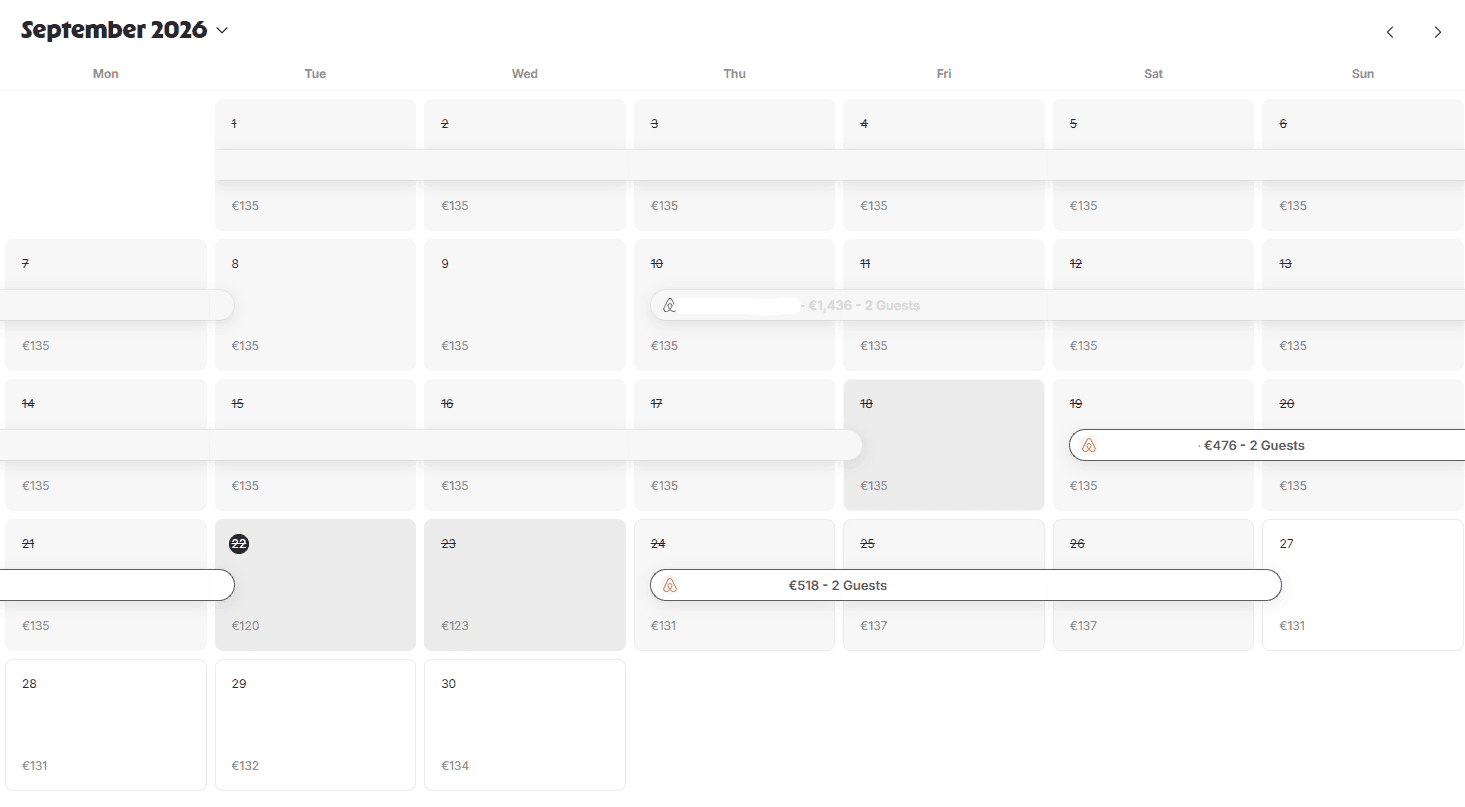
Taken on its own, this number might look like the main indicator of the property’s performance. In reality, it only tells part of the story.
A holiday rental on Lake Garda does not have the same commercial value all year round. Demand changes dramatically with the season and, as a result, so does the price a night can command.
For Altavista, the pricing strategy starts at roughly €90 per night in the lowest-demand periods, rises to the €120–180 range in the shoulder periods and can exceed €200 in high season, reaching around €300 per night at the summer peak, especially between mid-July and early August, when demand on Lake Garda is at its highest.
This means that a night sold in July does not have the same economic value as a night sold in November.
For this reason, the goal of management is not simply to reach the highest possible occupancy, but to find the right balance between occupancy and price, selling the most requested nights at the value the market is willing to pay and using different strategies in weaker-demand periods.
The 44.7% occupancy therefore has to be read together with other indicators: when were those 163 nights sold, at what price and through which channels?
The performance of a tourist property depends on the interaction of several variables:
occupancy × average price × seasonality × distribution.
It is this combination that determines the final revenue.
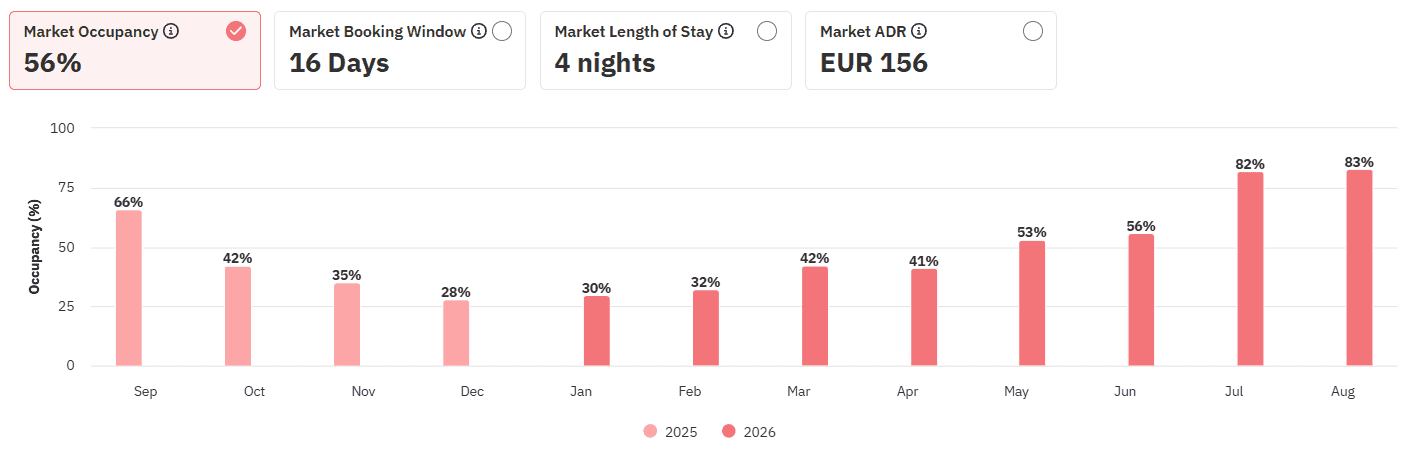
For Altavista, the 163 nights sold are therefore the result of a strongly seasonal strategy: concentrating sales capacity in the periods when the market shows the highest demand and willingness to pay, without necessarily chasing occupancy in the less attractive months.
This is one of the first elements that explains why occupancy and return are not the same thing.
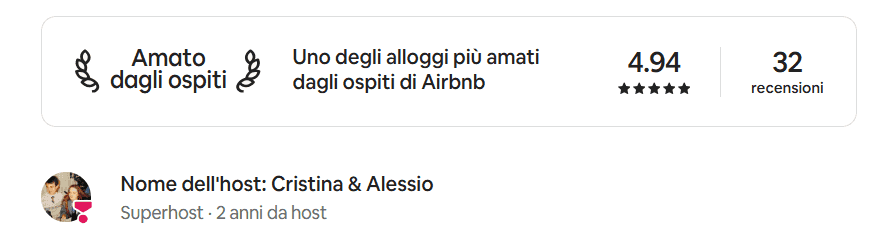
The first year is also about building a reputation
An important part of the work in the first year is not immediately visible in the profit and loss account.
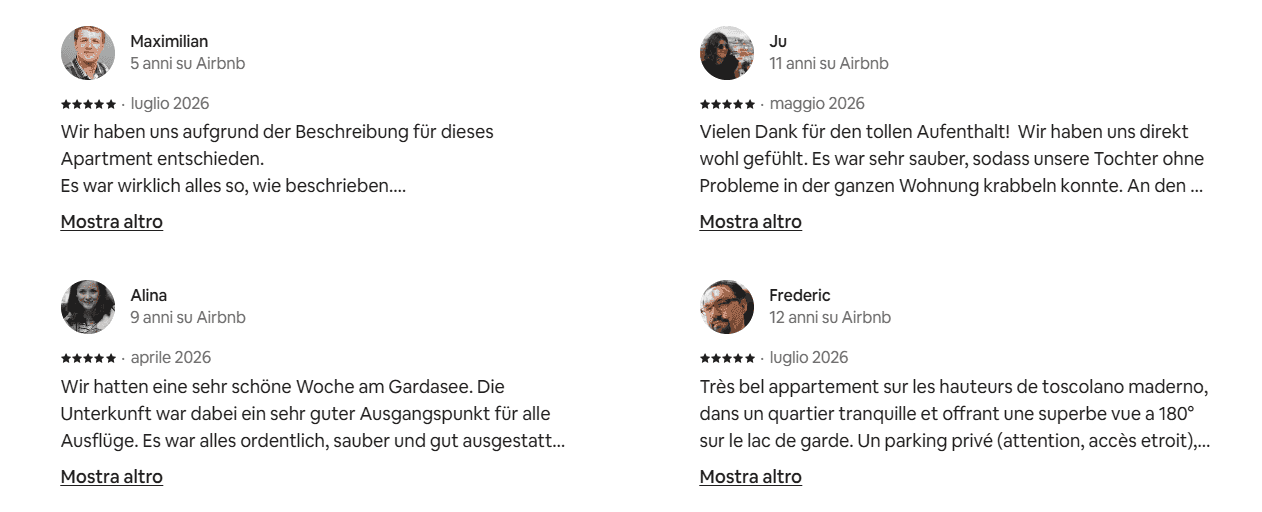
It’s the reviews.
Every stay produces something that remains after the guest leaves: a new review, a new rating and more credibility for the listing.
For Altavista, the work focused mainly on the main distribution channels:
Airbnb, Booking.com and Google.
The initial goal was to build a solid presence, collect real feedback and gradually understand which parts of the offer worked best.
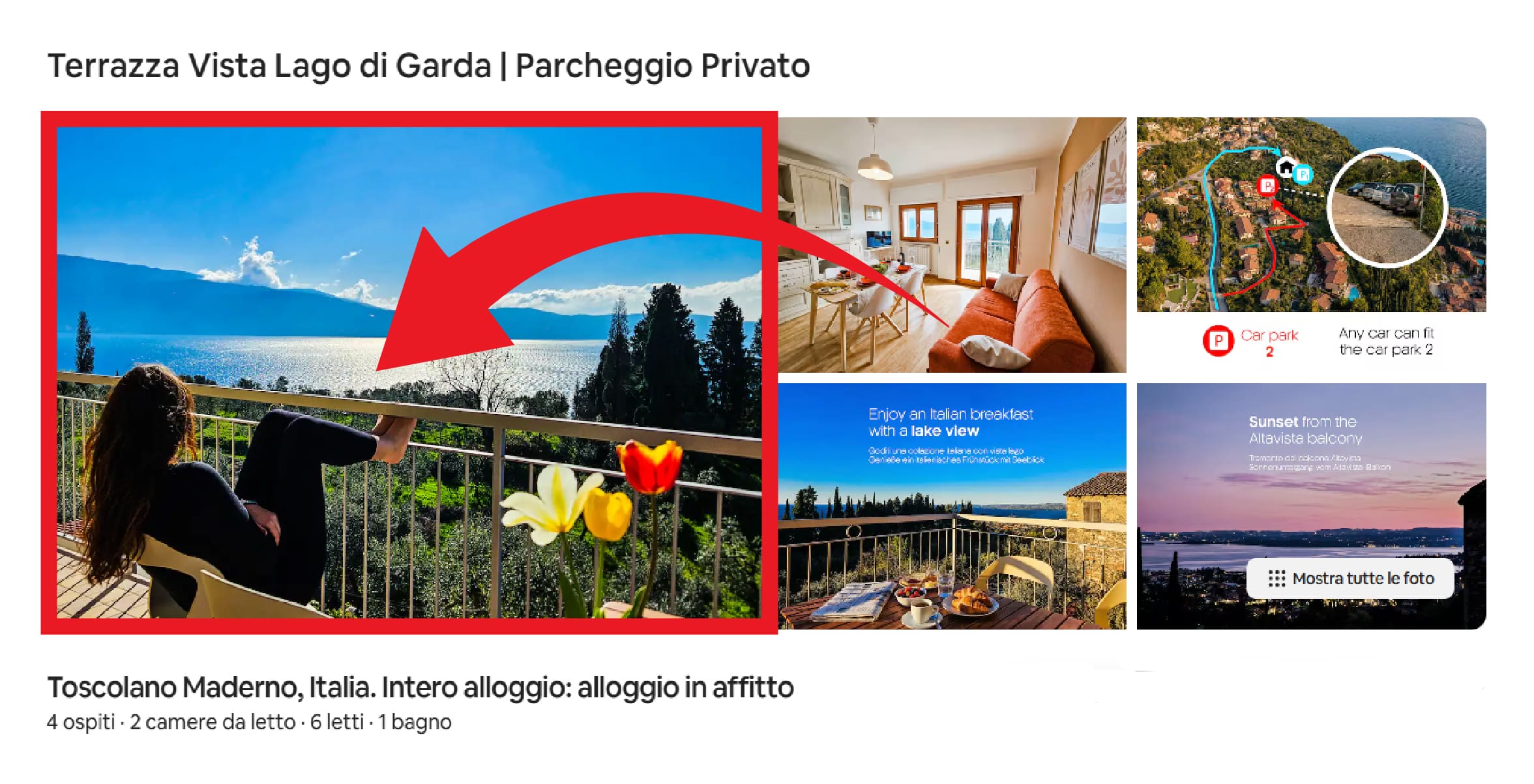
Photography is part of the product
A holiday rental is judged long before the guest arrives.
The first photo, the order of the images, the light, the view and the way the bedrooms and spaces are shown all shape how the property is perceived.
As we’ll see, the main photo is not decoration: it is part of the commercial strategy.
Here you can find the Airbnb listing for the Altavista apartment.
The first year is a learning period
2025 made it possible to build a track record and gradually understand:
- which periods generate the most demand;
- which rates the market accepts;
- which channels produce bookings;
- which photos work best;
- which features guests appreciate;
- which periods remain the hardest to sell.
This knowledge becomes particularly important in the second year.
The first year builds the track record.
The second year lets you use it.
And this is exactly where the Altavista case gets interesting.
Chapter 3
From revenue to real earnings: what’s left for the owner?
We now come to the question that probably matters most to anyone weighing an investment in a holiday rental and asking how much can an apartment earn on Lake Garda.
€24,362.99 in revenue: how much actually stays with the owner?
When people talk about short-term rentals, it’s easy to stop at the most visible figure:
“This apartment generated over €24,000 in revenue.”
But gross revenue is not profit.
Several items come into play before reaching the final balance:
platform commissions → cedolare secca → cleaning → management.
Only after accounting for them can we understand the owner’s actual financial result.
From €24,362.99 gross to the owner’s net balance
Altavista’s 2025 owner statement makes it possible to break down revenue very precisely.
| Item | 2025 |
|---|---|
| Gross revenue | €24,362.99 |
| OTA commissions | −€4,455.86 |
| Cedolare secca (flat tax) | −€5,116.22 |
| Cleaning | −€2,160.00 |
| GardaStays management fee | −€2,526.19 |
| Owner’s net balance | €10,104.72 |
These are the figures reported in the GardaStays owner statement, excluding utility costs such as water, electricity and gas.
The step is therefore very concrete: €24,363 in gross revenue becomes €10,105 of owner’s net balance in the first year
after the items listed in the statement.
The balance represents about 41.5% of gross revenue.
And this is precisely the difference between talking about revenue and talking about real return.
How much do platform commissions weigh?
In 2025, according to the breakdown: €4,455.86 in OTA (online travel agency) commissions.
The statement shows a commission of 15.5% + VAT for Airbnb and 15% + a 1.5% bank fee on the taxable amount for Booking.com. Direct bookings carry no OTA commission.
This means the channel a booking comes through has a direct impact on the financial result.
That’s why part of the management work also consists of gradually trying to increase the share of direct bookings, whenever possible.
The cedolare secca flat tax
One of the most significant items in the 2025 statement is the cedolare secca, Italy’s flat tax on rental income.
For Altavista, in 2025, the statement shows €5,116.22 of cedolare secca.
This means that over five thousand euros of gross revenue are absorbed by the tax component shown in the statement, for a private owner without an Italian VAT number (partita IVA).
It’s a figure that is often left out of superficial simulations of holiday rental profitability.
When you read:
“This apartment can generate €25,000 a year”
the next question should be:
“How much is left after taxes and costs?”
That is the figure that really matters to the owner.
Note: the statement refers to a private owner and the related tax simulation. The actual tax treatment must be verified based on each owner’s situation and the applicable tax regime.
Cleaning: €2,000 a year?
In 2025, the total cleaning cost shown in the statement was €2,160.
The statement shows a cost of €80 per stay, across 27 stays in total.
It’s a simple but important example. Each booking doesn’t only produce revenue.
It also creates a set of tasks and costs needed to be able to sell that same night again.
That’s why, when we ask “how much can an apartment earn on Lake Garda?”, we don’t only look at:
how many nights we sold.
We also look at:
how much value is left after covering the costs needed to sell them.
How much does professional management cost?
For Altavista, the GardaStays fee shown in the 2025 statement was €2,526.19
on €24,362.99 of gross revenue.
Professional management is therefore a cost.
But to assess it properly, you also need to consider what that cost actually buys.
Management includes activities such as:
- booking management;
- channel distribution;
- guest communication;
- calendar management;
- pricing;
- on-site assistance;
- cleaning coordination;
- review management;
- performance monitoring;
- operational tasks related to each stay.
So the comparison shouldn’t simply be:
“Do I pay a commission or not?”
The more interesting question is: what if we applied an 18% management fee?
To make the comparison clear for anyone evaluating a different property manager, we can simulate an 18% management fee, stating clearly the base on which it is calculated.
This makes it possible to compare different models:
Self-management
No management fee, but the owner directly bears the time and work required.
Professional management
A management fee in exchange for handing over operational and commercial activities.
Hybrid model
The owner can keep some activities and hand others over to a professional.
The point, then, is not to decide which model is universally best.
It is to understand which model gives the best balance between return, time, operational risk and quality of management for that specific owner.
From 10.6% gross to 4.4% after the statement items
On the purchase price of €230,000, 2025 gross revenue of €24,362.99 is equivalent to roughly 10.6% gross yield.
But using the owner’s net balance shown in the statement (€10,104.72 / €230,000) we get roughly 4.4% net yield, after the items considered in the statement.
These are two different numbers and they tell two different stories.
The first measures the property’s ability to generate revenue.
The second measures how much is left for the owner after the main financial items considered in the model.
And this is exactly the distinction we consider essential when assessing a property investment.
- Gross revenue€24,363
- OTA commissions −€4,456€19,907
- Cedolare secca (flat tax) −€5,116€14,791
- Cleaning −€2,160€12,631
- GardaStays management −€2,526€10,105
- Owner's net balance€10,105
Left for the owner Item deducted
Revenue tells you what the property produces.
Net income tells you what it produces for the owner.
Chapter 4
The second year: more revenue without necessarily filling more nights
The first year served to build the product, test the market and gather the first data. The second year makes it possible to use that track record to make more precise decisions.
And this is exactly where Altavista shows something interesting: in 2026, revenue is growing faster than occupancy.
Comparing with the first year
In 2025 Altavista recorded 27 bookings, for gross revenue of €24,363, with overall occupancy of 44.7%.
In 2026, at the time of the analysis, bookings are again 27, but gross revenue has already reached €27,903, while occupancy has risen to 46.3%.
| Item | 2025 | 2026* |
|---|---|---|
| Bookings | 27 | 27 |
| Gross revenue | €24,363 | €27,903 |
| Occupancy | 44.7% | 46.3% |
| Revenue growth | — | +14.5% |
*2026 figure available at the time of the analysis, carried out in September 2026.
The most interesting point is this: bookings are the same, nights sold have increased only slightly, but revenue has grown by 14.5%.
This means that growth doesn’t simply come from trying to fill the apartment as much as possible.
It comes mainly from the fact that each period of the year can be sold differently, depending on demand, seasonality and the price the market is willing to pay.
It’s not just nights: what matters is how much you sell each night for
In tourism, looking at the occupancy rate is not enough.
An apartment can be occupied for many nights and still earn less than one that sells fewer nights, but in the right periods and at the right price.
That’s why Altavista is managed with a revenue management approach: the price is not fixed, but adapted to the season, demand, time of year, booking lead time, length of stay and the property’s own track record.
The first year lets you understand what happens.
The second year lets you start predicting it.
It’s an important difference: it’s not simply about raising prices, but about understanding when it makes sense to do so and when you need to be more competitive to generate demand.
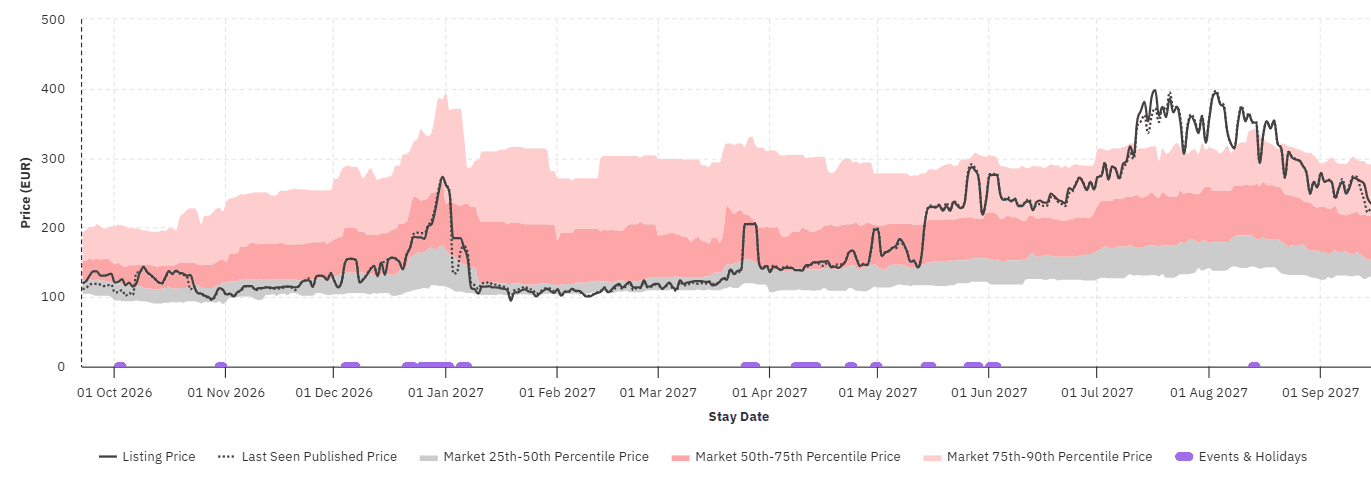
Distribution also contributes to the result. Airbnb and Booking.com make it possible to reach very broad demand, while direct bookings can reduce the weight of OTA commissions.
The 2026 result therefore shows that increasing a property’s return does not necessarily mean proportionally increasing the number of nights sold.
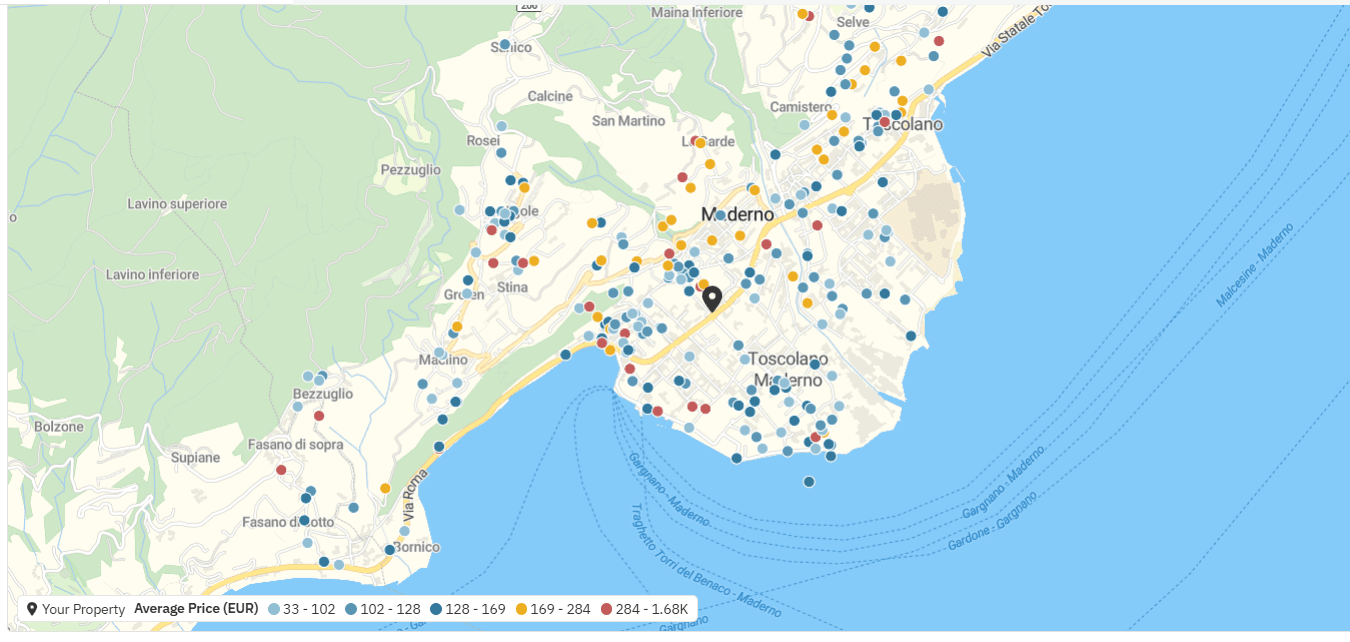
September 2026: the year isn’t over yet
There’s another key element to consider: this analysis was carried out in September 2026.
The €27,903 figure is therefore not the final result for the year.
Commercially interesting periods still remain, especially late autumn and the December holidays.
And above all, there is still the Christmas and New Year card to play.
This is not a purely theoretical assumption: in 2025 Altavista recorded a booking from 22 December to 2 January, worth a total of €1,488.
The track record shows that even a period usually considered weaker can generate demand when it is positioned and priced correctly.
That’s why the 2026 result should be read as a figure still in progress, not as a final account.
The potential of the second year
Based on the comparison with the previous period, an indicative projection takes 2026 revenue towards roughly €31,140.
It’s important to stress this: it is a projection, not the final result for the year.
If this scenario were confirmed, Altavista would go from €24,363 in 2025 to around €31,140 in 2026, with overall growth of roughly:
28% morein 2 years, compared with the first year of operation.
But the most interesting thing is not just the final number.
It’s the fact that this growth was achieved without turning the goal into a simple hunt for occupancy.
First, the product was built.
Then the market was observed.
Then data was collected.
And finally, that data started to be used to make better decisions.
And this is exactly where the next question arises:
how much could Altavista earn if, besides improving the return of the periods already used, we also managed to make the most of the months that today remain largely unused?
That is the step that leads to the hybrid model.
Chapter 5
From the seasonal to the hybrid model: how to increase the property’s return
The result Altavista achieved in its first two years makes it possible to go one step further. If we have learned to manage high-demand periods better, the next question is how to make use of those in which short-term rental becomes less effective.
Today Altavista is managed mainly as a holiday rental. It’s a model that works well when Lake Garda shows strong tourist demand, because it allows higher rates and the flexibility typical of short-term rentals.
But the same strategy can become less worthwhile in the low-season months, when demand drops and keeping the property exclusively on the tourist market can mean accepting long periods without bookings.
This is where the idea of a hybrid model comes from: using short-term rental when the tourist market allows the highest value, and considering longer stays in the periods when the property would otherwise risk sitting empty.
Not every month has to be managed the same way
A tourist property doesn’t have to follow a single usage model throughout the year. The strategy can change depending on demand and the value the market places on the property in a given period.
For Altavista, this could mean continuing to use short-term rental in high and mid season, when the location, the lake view and the apartment’s features command attractive rates, and considering longer stays in weaker-demand periods instead.
The goal would therefore not simply be to increase occupancy, but to reduce unproductive periods while keeping the ability to maximise price in the most profitable ones.
It’s an important difference. An apartment occupied for more nights is not necessarily an apartment that produces more value. Management has to consider price, occupancy, costs, flexibility and the ability to quickly return to the tourist market when demand picks up, all at the same time.
In Altavista’s case, January and March 2025 were also special months because they were devoted to preparing the property after the purchase. They therefore can’t be read simply as low-season months: they represent a start-up and transformation phase for the apartment.
How much can an apartment earn on Lake Garda with the hybrid model?
To understand concretely what this approach could mean, we can build a very simple scenario.
Let’s assume we manage to monetise four months currently considered low season (January, February, March and November) at an average rent of €900 per month.
We are not saying this result has already been tested on the market or that it is guaranteed. It is a simulation that helps understand the order of magnitude of the potential.
| Scenario | Amount |
|---|---|
| January | €900 |
| February | €900 |
| March | €900 |
| November | €900 |
| Additional gross revenue | €3,600 |
| Assumed cedolare secca 21% | - €756 |
| Increase after flat tax | €2,844 |
With this simple assumption, four months that might remain essentially unproductive under a purely tourist model would generate €3,600 of additional gross revenue.
Applying, purely for simulation purposes, a 21% cedolare secca flat tax, €2,844 would remain after tax. The actual tax treatment must of course be checked against the owner’s specific situation and the type of contract used.
The figure becomes even more interesting when compared with the 2026 projection developed in the previous section.
Starting from a projection of around €31,140 in gross revenue for 2026, introducing the hybrid scenario would bring the theoretical gross potential to:
| Item | Current model | Hybrid scenario |
|---|---|---|
| 2026 revenue projection | €31,140 | €31,140 |
| Additional low-season revenue | — | €3,600 |
| Potential gross revenue | €31,140 | €34,740 |
| Flat tax on new revenue* | — | - €756 |
| Increase after flat tax | — | + €2,844 |
*Simplified assumption with a 21% rate, to be checked against the owner’s actual tax situation.
In this scenario, the hybrid model would therefore add roughly €2,844 after the flat tax alone, taking the theoretical result from €31,140 to around €33,984 after tax on the new revenue.
Of course, this does not mean that €33,984 is Altavista’s final return: to reach a true profit and loss account we would also need to consider any management, maintenance, utility, cleaning and commission costs and, above all, the opportunity cost of not being able to use those same periods for tourist rental.
But that is exactly why the scenario is interesting. We are not trying to predict the future with an arbitrary figure; we are measuring the economic value of a possible alternative management approach.
From the hybrid model to smarter management
The real advantage of the hybrid model, then, is not just generating some extra revenue during the weaker months.
It’s the chance to make management more flexible and more data-driven.
Altavista’s first year created the track record. The second year made it possible to improve prices and returns. The next step is to use this data to understand how to distribute the property’s use differently across the year.
Each period can thus become an economic decision: how much is a night sold as a short stay worth? How much is it worth to commit the apartment for a month instead? What costs do the two alternatives involve? How much flexibility do we lose? And which of the two strategies produces the better overall result?
Professional management therefore becomes more than just handling bookings. It means constantly comparing different ways of using the property and choosing, period by period, the one that can create the most value.
For Altavista, the hybrid model is therefore a possible evolution, to be tested and measured over time. Not a promise of returns, but a new management lever that makes it possible to see the property not just as a holiday rental, but as an asset that can be optimised throughout the year.
And this is exactly the shift from traditional management to property performance: not simply trying to fill the calendar, but understanding how every decision on price, length of stay, distribution and use can change the property’s overall return.
Conclusions
Conclusions: the real value is not just what a property earns today
The Altavista case shows that the return of a tourist property is not a fixed number, determined only by its location or purchase price.
The property was bought for €230,000, turned into a tourism product, positioned on the market and managed through a gradual process of collecting and analysing data.
In 2025 it generated €24,363 in gross revenue. By September 2026 it had already reached €27,903, with an indicative projection that could take the annual result towards €31,140. And the hybrid model analysed in this article shows that there are further ways to make the most of the periods that are currently under-used.
But the most important figure is none of these numbers taken on its own.
It’s the method.
A property can be improved. Its positioning can be changed. Prices can be optimised. The periods of the year can be managed differently. And every decision can be measured through the results it produces.
This means that the value of a home on Lake Garda shouldn’t be judged only on what it has produced in the past.
The more interesting question is:
How much can an apartment earn on Lake Garda if it’s managed to its full potential?
And this is exactly the question that GardaStays’ work starts from.
For owners
How much can an apartment earn on Lake Garda? Find out for yours.
Altavista is a real case, but every property has different characteristics.
A lake view, a pool, a terrace, the number of bedrooms, the location, the distance from the main attractions, the seasonality of the area and even the way the spaces are presented can radically change the financial result.
That’s why applying an average percentage to the property’s value is not enough.
You need to analyse the property, the market and the management model together.
GardaStays is developing a property performance approach that starts precisely from this analysis: understanding where the property stands today, what its strengths are, which opportunities are not yet being used and which interventions can produce a measurable financial return.
Want to discover your property’s potential and answer the question “how much can an apartment earn on Lake Garda?” Request a GardaStays analysis below.
We help you understand:
- how much your property could earn;
- the answer to “how much can an apartment earn on Lake Garda?”;
- which management model may suit you best;
- which periods of the year can be better used;
- which improvements to the property can have a real impact on its return.
We don’t start from the question “how much does it cost to manage?”.
We start from a different question:
“How much value are we leaving on the table?”
FAQ
Frequently asked questions
How much can an apartment earn on Lake Garda?
In the real case of Altavista, a two-bedroom apartment for up to four guests in Toscolano Maderno bought for around €230,000, the first year of operation (2025) generated €24,362.99 in gross revenue from 27 stays and 163 nights sold. After OTA commissions, cedolare secca (Italian flat tax on rental income), cleaning and management, the owner kept €10,104.72, about 41.5% of revenue, excluding utilities.
What is the net rental yield of a holiday rental on Lake Garda?
For Altavista, the gross yield on the purchase price was 10.6% in 2025, while the net yield, calculated on the owner’s net balance in the statement, was about 4.4%. The result varies with location, property features, seasonality and management model.
How much do commissions, taxes and cleaning take from short-term rental revenue?
In Altavista’s 2025 owner statement, platform commissions were €4,455.86, the cedolare secca flat tax €5,116.22, cleaning €2,160 (€80 per stay) and the management fee €2,526.19, on €24,362.99 of gross revenue.
Does a holiday rental earn more in its second year?
In Altavista’s case, yes: by September 2026, with the same number of bookings as in 2025 (27), gross revenue had already reached €27,903, 14.5% more, with occupancy of 46.3%. The indicative projection for the whole of 2026 is about €31,140, roughly 28% more than the first year.
What is the hybrid model for a holiday rental?
It is a management approach that uses short-term rentals in high and mid season and longer stays in the low-season months. In the scenario simulated for Altavista, four months at €900 per month would add €3,600 gross, about €2,844 after an assumed 21% flat tax.